Saturday, July 7, 2012

Skimming the Surface of the Liturgical Year


For several years now I’ve been wanting to try observing Lent.  I didn’t grow up in a church that observed any of the liturgical year (except Christmas, Good Friday and Easter), and I was curious.  But I didn’t want to jump into a long period of fasting without understanding why people give up something before Easter.  I received a copy of The Liturgical Year by Joan Chittister from the publisher in order to review it.  In reading it I hoped to understand Lent, and also to see what the rest of the liturgical year was about.

Most importantly, after reading this book, and specifically the chapter on Asceticism, I felt ready to observe Lent.  Because of that I got the main thing I wanted to out of this book.  There was also an excellent chapter on joy, and Chittister’s writing style was very poetic.  However, I would have loved to learn more about each feast itself.  I felt that the reader needed to already have a somewhat working knowledge of the liturgical year to understand this book.  I would have liked to have learned how the feasts are observed.  The beginning chapters were a bit long as well.  Less telling us what we’re going to read about and more meat in the book itself would have been nice.

All in all, The Liturgical Year was a helpful and beautiful read.

Tuesday, May 3, 2011

I thought it would be fun to check out a picture book for my next review, so I asked Waterbrook to send me a copy of Lisa Tawn Bergren’s God Gave us the World, illustrated by Laura J. Bryant. They were nice enough to comply. I used two test subjects to help me with my review—Jase, age 6, and Joy, age 7.


This adorable picture book follows a family of polar bears as they visit a museum exhibit of bears around the world. The mama bear explains to one of the little bears that God made all sorts of bears, all of them different. When the little bear asks why he didn’t make all bears the same she shows him how fun the differences in bears can be.

It was a hit! As soon as we closed the book Jase asked to read it again. He giggled his way through both readings, loving the pictures. He also had a fun time reading the signs on each page that showed what exhibit in the museum was next. When we read the pages describing the differences bears have (some are quiet, some are loud, etc) he acted out the descriptions. Both times. Jase gave the book a 10 out 5.

Joy also liked the book, saying she liked the pictures the best. When I asked her what her favorite part was she said, “the bears,” because they were cute. She didn’t say a lot about the book (she’s a quiet one) but she gave it a 4 out of 5.

The only complaint we had were a few pages in the middle of the book that went on for quite a while about the attributes of God. While sharing the wonderful aspects of God with our children is great, it took us out of the story. I would have loved to see it integrated into the action more or just have that section pared down to one or two sentences. When I was reading it I could feel that it was dragging and when I asked Jase if there were any parts that he didn’t like, he pointed to those pages. “They’re not doing anything fun,” he explained. Fortunately, the rest of the book was plenty fun.

All in all, God Gave us the World was a hit. It will be a repeat read for years to come for sure.

Thursday, February 17, 2011

The Narnia Code


When Tyndale e-mailed me offering to send me a complimentary copy of Michael Ward’s book The Narnia Code, I was wary. Was this going to be a conspiracy theory book claiming that CS Lewis wasn’t really a Christian? I had no need for a book like that. However, after doing a little research I found out that Ward is a big fan of CS Lewis and even lived at the Kilns, Lewis’ old home. He wasn’t going to slander Lewis’ name. I gave Tyndale the go ahead.

In The Narnia Code, Ward explains his theory that CS Lewis based each of the books in the Chronicles of Narnia on one of the pre-Copernican planets—the sun, the moon, Mercury, Venus, Mars, Jupiter and Saturn. Lewis was extremely familiar with the medieval views of the heavens, in which the Earth was the center of the universe and everything else circled around it. Each planet had certain characteristics attributed to it, which Ward claims go along with the Narnian Chronicles. For example, Prince Caspian has the spirit of Mars, the war planet. In most of the books the greatest evidence of the spirit of the planet is found in how Aslan is portrayed.

I have to admit, Ward makes a good case. His theory explains some of the random things Lewis put in the Narnia books, like Father Christmas appearing in The Lion, the Witch and the Wardrobe, and Bacchus appearing in Prince Caspian. I wouldn’t go to my death defending his ideas, but I do think what he said is possible. The evidence he gives makes sense.

The Narnia Code is a good read for any Lewis fan (and you’ll want to be familiar with The Chronicles of Narnia before reading The Narnia Code). As someone who is quite familiar with Lewis, I learned quite a bit, not only about the Chronicles of Narnia, but also about his science fiction trilogy (of which I’m a huge fan), and Lewis himself. Ward also touches on history and science. Really, it’s quite the informative book. It is, however, a bit on the academic side. It reads a little like a very long research paper, but an interesting research paper. Interesting, but not intriguing—it was easy to put down, and sometimes I would forget to pick it back up for a while. Once I did pick it back, however, I almost always found something interesting in it.

If you’re like me and have a wall hanging made from the pages of The Magicians’ Nephew, give this book a try. Okay, even if you don’t have Narnian themed décor I think you’ll still enjoy it.

Sunday, January 23, 2011

Don't Pass This By

By far, Under the Overpass by Mike Yankoski has been the best book I’ve received from a publisher so far (Yes, it’s true. Waterbook Multnomah sent me the book in exchange for an honest review). Right now there are 10 books by my bed with bookmarks in them. The competition for my time is high, but Under the Overpass consistently made it off the stack and into my hands.

Let me introduce you to the two main characters in this gem of a memoir—Mike and Sam, two college-age guys who are homeless. They didn’t loose their jobs. They didn’t succumb to addiction. They didn’t get kicked out of their parent’s houses. They chose to live on the streets to find out what it would be like to fully rely on Christ for all their needs. Intense, right? I would never want to go on that adventure, but I sure did enjoy reading about it. Traveling from Denver to DC, Portland to San Francisco, Phoenix to San Diego, they slept through rainy nights and panhandled in over 100 degree weather. They got ignored and they got loved. Sometimes the people who you would expect to love them the most treated them the worst, and vise versa.

What I loved about Under the Overpass was the story. I wasn’t reading a book about how to help the homeless. I was reading a story that involved a lot of homeless people—a story that caught me up and made me want to keep reading. It was within that story I saw some of the issues that homelessness brings. I saw interactions that were helpful and encouraging and I saw reactions that were harsh. It made me want to act like the people who were loving toward Mike and Sam, and to make sure I didn’t act like the people who ignored them and treated them like they weren’t human. That’s way more life changing than reading a book telling me facts about homelessness, in my opinion.

Whether you read it because you’re looking for an interesting story or you read it to be inspired, I think you’ll be glad you read Under the Overpass.

Saturday, January 8, 2011

Here are Some Books that you Should Read

The last few blogs I’ve posted have been about books that were sent to me from the publisher for reviews. They weren’t amazing. I don’t want my blog to be only about book that are okay, and ignore the books I’ve been reading that I have absolutely loved. So I thought I would write about a few books that I would whole-heartedly recommend. Today I’d like to tell you about two middle grade/young adult series I’ve recently read.

The first is The Wind on Fire Trilogy by William Nicholson. It consists of three books, starting with The Wind Singer. There are three books in the series, which seems like it would be obvious seeing as it’s a trilogy, but you don’t know how many “trilogies” that I’ve read that end up having four books in them. What is the world coming to?

The reason I so whole-heartedly recommend this series is the fantastic creativity in the books. Remember the first time you read The Voyage of the Dawn Treader? Well, I don’t. I was way to young to remember that. However, I do remember the last several times I’ve read it. I love the way each island is totally different from the others and has it’s own culture and intrigue. This series is much the same. It focuses on three children—Kestrel, Bo and Mumpo—who come from a society much like the kind you see in The Giver or City of Ember—very regulated, no room for going against the leaders of society. They find out that life in the city isn't as great as it seems, and they leave to save the ones they love. As they travel they encounter cultures that are vastly different from their own, or from any that I’ve read in other books. Each time they came to a new place I was floored anew. How did Nicholson think of such things? That’s just the first book. The next two are wonderful as well, but I won’t get into what they are about, lest I give away what happens in the first one.

The second series on my must-read list is the Mysterious Benedict Society by Trenton Lee Stewart. So far there are three books in the series, but I don’t think it’s claiming to be a trilogy, so more might be one the way. I’ve read the first two, and I’m looking forward to the third one in a big way.

The feel of the book reminds me a bit of A Series of Unfortunate Events. Four insanely talented kids who are alone in the world respond to an ad in the newspaper for gifted children and find themselves in a mission to save the world. They have to go undercover as students at the Learning Institute for the Very Enlightened to stop the headmaster from taking over the world through controlling the minds of everyone. Good times indeed. What I especially love about these books is how each of the four children have their own set of unique abilities. One can figure out patterns and riddles like a genius, one is the handiest girl you’ll ever meet, one can remember any bit of information he’s ever come across, and one…well, you’ll have to get to the end of the book to find out about her. All of their skills and personalities are necessary to completing their mission-a theme that is dear to my heart.

So there you have it—some exceptional books to entertain and enlighten. I’ll continue to post my review on the books that publishers send me (I’m now getting books from three different publishers!), but I’m going to try to take the time to write about the books that I’m reading on my own.

The Scoop on The Secrets Beneath by Kathleen Fuller

When I first heard about The Secrets Beneath by Kathleen Fuller I was pretty excited. It’s about an Amish girl who sees a man digging in the yard of the house next door and tries to find out what is going on. There were three reasons I thought I would like the book. One, it’s about the Amish. I love the Amish. I even wrote a research paper on them in college. Two, it’s a mystery. Mysteries are totally fun and intriguing. Three, it’s “juvenile fiction” (a term only Christian publishers use. I figure it was middle grade – late elementary). I love middle grade to young adult books. It’s what I mostly read. I was ready for a fun read.

I was sorely disappointed. The Amish-ness of the book was lacking. Instead of giving us a peek into the rich culture of the Amish, Fuller portrayed them as slightly old fashioned, up-tight and conservative people. There is so much more to Amish culture that she could have shown us but didn’t. Then there was the issue of the mystery. It wasn’t intriguing. I honestly didn’t care what was going on at the house next door. The suspense wasn’t there. There was more suspense about if the main character’s mother was going to give her a scolding than what was buried next door.

Then there’s the issue of the writing. Mainly it came down to the fact that the author did way too much telling and not enough showing (which is the cardinal no-no of fiction writing). Here’s an example of what I mean. “Bekah wasn’t surprised that her mother would offer hospitality. That was the Amish way.” If I wanted to have someone tell me directly what the “Amish way” is, I’d read a textbook on the Amish. This is a novel, so I should be able to glean what goes on in Amish communities by seeing it happen, not by the narrator pointing it out to me. The problem isn’t just that it’s written for children. There are plenty of children’s authors that do a fine job of bringing out themes and even information in a creative way.

All in all, this book had real potential, but it didn’t reach it. If you’re looking for a fun way to read about the Amish or introduce your children to Amish culture and good books, look elsewhere.

I was sent a complimentary copy of this book to review for Thomas Nelson.

Thursday, September 23, 2010

The Skin Map


I’ve signed up for a program in which I receive free books in exchange for book reviews (see www.booksneeze.com for more info or to sign up for yourself). You know me, I can’t pass up free books!

First up is Stephen Lawhead’s The Skin Map, the first book in his new Bright Empires series. It’s about a group of people who travel via ley lines—portals that lead to other times and places. Some people are in search of a map originally tattooed on a man’s torso, while others are looking for loved ones who have gone missing in the midst of their own inter-dimensional travel. It’s somewhat of a mix between National Treasure and The Time Travelers Wife, and I found it entertaining. Less of a sci-fi or fantasy book, it feels more like a historical novel, taking place in England, Prague and Egypt. I must say though, if you find it hard to keep up with plots that don’t follow a linear time-line, you may find The Skin Map confusing (ie, if the flash-sideways in the last season of LOST mystified you, this may not be the book for you).

The Skin Map felt as if it were merely a setup to the next books in the series. The suspense didn’t kick in until page 330, leaving 70 pages to bring up questions that won’t be answered until later. I wish we could have gotten more closure or more info on why the characters are traveling through time and searching for the skin map so frantically. I suppose the open-ended ending is there to keep you reading the series, but I think even in a series a book should have it’s own story that rests on itself. At the end of Harry Potter and the Sorcerer’s Stone we don’t know everything behind Lord Voldemort’s return, but there is a complete story with a beginning, middle and end. The Skin Map seemed to only have a beginning and middle. Even so, I give the book 4 stars.

Thursday, June 10, 2010

Cain and Abel


For the past five years I've been on a literary journey of my own choosing. I'm reading all of Madeleine L'Engle's books in the order they were published. I don't read her books exclusively, and she was very prolific, so it's taken me awhile. Right now I'm reading her 29th book out of 63. Some books are young adult novels, some are novels for adults, some poetry, some memoir, some books of prayers, and some theology.

There are certain books that I eagerly look forward to and others that I pick up only because they are on the list and I've committed to reading them all. At least once I've made a comment like, "I'm not really looking forward to reading this one" to a friend. That friend has responded with, "Then why don't you skip it?" But reading the books that I'm not naturally drawn to is what makes this journey rewarding. It teaches me things about faith and about Madeleine L'Engle that I wouldn't know if I only stuck to the books I'm most drawn to. And each time I read one of the books I am less than excited about I find a treasure.

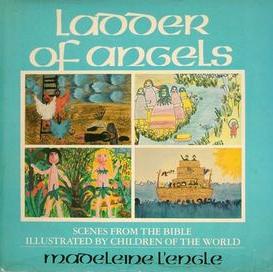
The book I'm reading right now is called Ladder of Angels. In it Madeleine retells familiar Bible stories, and next to each story is an illustration by a child from somewhere throughout the world. Let's just stay this was not one of the books I was desperate to read. I mean, I know these stories. I grew up in Sunday School and have read them over and over in the Bible. And really, do I want to see a bunch of pictures by kids I don't know personally? But I started reading it and was, of course, pleasantly surprised. Some of the pictures are astounding! I am so impressed by the kids' artistry. And the oh-so-familiar Bible stories are fresh with Madeleine's words. One of my favorites so far has been the story of Cain and Abel, so I thought I would share it with you here.

There had never been children before.
Eve did not know what was happening to her, with her belly swelling and movement within it and then a great ripping and tearing. There was terror and there was pain.
And then, Cain, squalling, red-faced and angry at the indignity of birth. The first child. He would have preferred simply to have been formed of dust.
When Abel was conceived Eve understood what was happening, so perhaps it was easier to hold Abel, to gentle him against her breast, knowing that the hungry lips were searching only for milk, not trying to bite and hurt and destroy.
The two children romped like lion cubs. They vied for love. They loved and hated and were jealous. But it was all easier for Abel.
So Cain hit him. There had never before been death. He did not know why Abel did not get up and hit him back.
He did not know that he had brought death into the world, and that, as he would bear its mark, so would we.
Cain resented Abel, and bequeathed us his death.

I suppose it's a little dark for me to say this has been one of my favorite stories in the book thus far. It's not that I love reading about the first murder. It's just I found this story so interesting. I've read the account in Genesis 4 so many times, but I'd never thought about how scared Eve must have been when she was pregnant with the first child ever. Or that Cain might not have realized that when he attacked his brother it would end his life. They had experienced animals' deaths, but I wonder if the first family realized the same thing could happen to them.

I've got quite a few mores stories to go in Ladder of Angles, and then I get to move on to a young adult novel! It's a fun journey. What are you reading these days?

Saturday, June 5, 2010

A Tropical Paradise?

I wrote a devotional for a prayer guide that a group in my church is putting together this summer. I thought I would share part of it here on the blog.


When I was in college my roommate and I had a picture of one of the tropical islands in the Maldives on our dorm room door. It had gorgeous white sand that stretched out to meet beautiful turquoise water. There was something about the picture that soothed me. Yet at the same time it gave me a deep longing.

When I am tired and stressed out and I just want to get away from my life I think about going to a place like Maldives. Something in me aches for more than what I find in my daily life. I think that getting to a place like Maldives will make it go away. Yet I’ve been to beautiful places before and it doesn’t make the ache going away. It makes it even worse.

C.S. Lewis knew about this ache too. In Mere Christianity he writes, “If I find in myself a desire which no experience in this world can satisfy, the most probable explanation is that I was made for another world.”

We call tropical islands "paradise", another word for heaven. When I’m honest with myself I realize that’s what I’m looking for—a little piece of heaven on earth. But to expect heaven before our time on earth is over is setting ourselves up for disappointment. You’re not going to get the fulfillment you’re looking for in this life. Not completely. That sounds a little depressing. And if this life is all there is, it would be depressing. Thankfully we have HOPE. We have a promise that this is not all there is. Read what Paul writes in Romans 8:20-25.

"Against its will, all creation was subjected to God's curse. But with eager hope, the creation looks forward to the day when it will join God's children in glorious freedom from death and decay. For we know that all creation has been groaning as in the pains of childbirth right up to the present time. And we believers also groan, even though we have the Holy Spirit within us as a foretaste of future glory, for we long for our bodies to be released from sin and suffering. We, too, wait with eager hope for the day when God will give us our full rights as his adopted children, including the new bodies he has promised us. We were given this hope when we were saved. (If we already have something, we don't need to hope for it. But if we look forward to something we don't yet have, we must wait patiently and confidently.)”

It doesn’t matter where we are, whether it is in the suburbs of LA or a gorgeous tropical island. There are certain longings in our life that will never be fulfilled on this side of eternity. That ache will always be there until we are united with Christ in heaven. One day, as followers of Christ, we will have all our longings fulfilled. We will finally be complete.

Tuesday, June 1, 2010

They Never Came Back


So there I was, on the elliptical machine at my gym, wondering if the woman two spots down could hear my quick breaths, indicating that tears could be forthcoming at any moment. I had just finished reading Caroline B. Cooney's novel They Never Came Back and I was thinking, "This is exactly the type of novel I want to write."


I found the book while I was strolling through the library's section of new novels for children and teens, and the sparse words on the back of the book caught my attention.


Cathy decided on facts. "I don't live here in Greenwich," she told him. "I live in Norwalk."


"You look like Murielle," he insisted.


She asked the logical question. "And who is Murielle?"


This caught my attention because I thought it might be similar to the novel that I'm writing. In case you don't know, my novel is about a girl who shows up at her new school and to everyone else she looks like another girl who already goes to that school. She has, in fact, replaced the girl and continues to trade places with this girl, pretending to be her, until she can figure out how to make it stop. I thought They Never Came Back might have a similar situation in it, so I checked it out. Anything that sounds like it could be remotely similar to my book gets my attention because 1) I want to see how the author handles the situations we share in our novels and 2) I find the topics interesting (that's why I'm writing my own novel about it).


As it turns out, the book's plot was nothing like mine. It's about a teenager who looks like a girl who was lost to her family when she was put into foster care years before. The question throughout the novel is whether the high school girl is really the little girl who was lost five years ago or just someone who looks like her.


I'm so glad that the book gave so little information on the back because I probably would not have read it if I knew what it was really about. I have my list of what I tend to look for in books. I like them to include one or more of the following criteria:


-Novels that mess with time and space

-Books written by Madeleine L'Engle

-Memoirs about random events in life like not buying anything unnecessary for a year

-Books written by Donald Miller

-Novels that take place in pre-modern England

-Novels that have modern day characters who turn out to be wizards or demi-gods

-Books (both fiction and non-fiction) that incorporate faith in a creative non-cheesy, non-preachy way

-Books about Amish people

-Novels with other worlds or magic

-Young Adult novels that take place in the future after most of civilization has died off and now humanity is making a new start

-Historical Fiction*


You may notice that foster care is not a part of the list. It's not something that I usually read about. Yet I'm so glad I read this novel. Along with foster care there were other fantastic themes in the book-identity, family, God, how our personal choices affect those around us, etc. The reason why I say it is the type of novel that I want to write is because it has such a wonderful mixture of entertainment, faith-filled themes (it is not a "Christian" book), lighthearted relationships (ie high school crushes) and thought provoking concepts. I think I may have found a new favorite author. I can't wait to check out Cooney's other novels.


*If any of these genres interest you and you would like some recommendations let me know. I would love to share my favorites with you.

Monday, May 3, 2010

A Million Miles Down a Wandering Path

Let me tell you a little bit about Donald Miller’s book A Million Miles in a Thousand Years. In this fantastic book Don talks about how our lives are like stories. Some stories are better than others. Good stories make us cry at the end (Some of us cry more than others. I cried at the end of The Little Mermaid in first grade. Most people don’t cry during animated films, with the exception of Pixar's Up, which will wring tears from a statue. Something that emotionally flammable is a health hazard for me. I actually stopped breathing for a few seconds when I saw it in the theater). Yet other stories don’t affect us at all. A movie about a person who really wants a Volvo and works hard to save up for one doesn’t bring tears to your eyes as the main character drives off testing out the windshield wipers. It’s not a satisfying story, because it’s not meaningful. Your life isn't going to be satisfying with that plot either.

Part of Donald Miller’s story is that he grew up without a dad. Now he is bringing meaning into his story by taking on fatherlessness in the United States with his organization The Mentoring Project. Check out this video they made:

The Mentoring Project - Rewriting the Story from The Mentoring Project on Vimeo.

As I finished reading A Million Miles I started asking myself the question, “What kind of story am I living?” Frankly, there’s a lot that I like about my life right now. On day one of this year I decided 2010 was going to be about being bold, taking risks and kicking butt. And it has been. I signed up with a personal trainer at my gym and have been loosing inches. I delved into the second draft of my novel, determined to whip it into shape. Where I used to think, “That’s not me,” or “I couldn’t do that” I now think, “Why not?” It’s been an entertaining and adventurous story.

But is it a good story? Is it a meaningful story? I’m not ending fatherlessness and shutting down 20% of prisons like Donald Miller is trying to do. I don’t have a major cause that I’m fighting for. I started thinking I needed to get myself a cause. I also started stressing myself out.

Then someone died. I didn't know the woman personally, but she was the mother of someone dear to me, and I was given the opportunity to help with some of the preparations for her memorial service. After I’d printed and folded hundreds of papers for the program, gathered food and trays for the reception, and made sure there was waterproof mascara on hand I realized what an honor it was to be able to do such practical and tangible tasks for someone during their time of loss. That is meaningful.

I thought a meaningful storyline would have a specific direction, a focused determination making a big difference in the world. It's certainly easy to see how a life like that would have lots of meaning. But couldn't it also be more of a wandering path? The journey to find meaningful bits in each day could be the storyline itself. I have to believe so, because what about all the women who are mothers, at home with their children every day, raising them in love, teaching them what life is about? That is a worthy cause, is it not? But it is not something you log your hours in for, nor something that gets recognized when filling out applications for fellowships and nominations. But it is a calling I hope to join some day. And I've heard that it is a struggle to feel like your life is meaningful when you are at home with the kids day after day. Much of my job is wrapped up in doing those motherly tasks, so I need it to be true for me right now as well. I want and I need to take the time to practice finding those meaningful moments. I need to allow myself to count the seemingly small things as important. Because it's all too easy for me to dismiss whatever it is that I'm doing with, "Well, that doesn't count."

If our lives feel meaningless, is it because they lack meaning, or that we lack trust that what it is we are doing actually is meaningful? I have a feeling that even if I were working for the greatest cause in the world I would find a way to discount it and not feel like I was doing enough. Maybe I am working for the greatest cause in the world and I don't even realize it.

Tuesday, April 20, 2010

Road Trips to Wonderland


Today in the Daily Office we started reading Colossians. Every time I read Colossians I think of the road trip my friends and I took to Oregon during my senior year of college. It was during this trip that I fell in love with the book. From then on I've counted it as one of my favorite books of the Bible, along with Romans, John and Isaiah.


That trip also reminds me of two other books. Charlie and the Chocolate Factory by Roald Dahl, and Blue Like Jazz, by Donald Miller. I read more books than that on the trip, but that is what I remember reading.


Most of the group on that trip had just read, were in the middle of reading, or started reading Blue Like Jazz on the trip. It was perfect timing, as we were headed up to where Don lived. We even visited the famed Powell's Bookstore that he mentioned. It was perfect. Reading books that tie in with where you are visiting is the best way to do it, in my opinion. Sir Walter Scott in Edinburgh. Charlotte Bronte in Haworth. Miller in Portland.


So now I'm reading Donald's new book A Million Miles in a Thousand Years at the same time that I'm reading Colossians again. In a sense it's like both books were chosen for me at this time. A Million Miles because I just heard Donald speak on it last week, and Colossians because the Episcopal church said that's what I should read right now. It's one of those things that seems lined up, providential. Actually, it seems cyclical.


There are things in my life that seem to keep showing up, reminding me of who I am and who I was. Of course there are the negative things that I wish didn't come up - those insecurities that I thought I got over years ago that come back at times when I least expect them. But I'm thinking more of those things that are more nostalgic in nature. Like a beautiful, although sometimes seemingly random, theme in a movie that keeps showing up.


Take Alice in Wonderland for example. The new Tim Burton version starring Johnny Depp came out recently. I love anything those two do together, so of course I went to see it, and I started remembering all the different ways the story of Alice in Wonderland had shown up in my life over the years. There's the Disney version of the movie, which is not my favorite (although I do like the ride at Disneyland). But then there's the live action version that I watched on TV as a child. The book by Lewis Carol that I adored, especially the second half, Through the Looking Glass. The Alice in Wonderland game for our CD-i, a learning and gaming technology that my family bought that never quite caught on. There's the visit to Alice's Shop in Oxford where my parents bought me the "Drink This" mug. Also the new book series The Looking Glass Wars by Frank Beddor that I've been reading. All of these things came up in my mind as I watched Tim Burton's version of Wonderland. It's like I was being re-introduced to that part of me that loves Alice in Wonderland. It's kind of like those people that you are friends with on Facebook. You know them, but you forget about them until they post a status update on Facebook on something you have in common with them.

I'm not really sure what all these reminders come to, but they seem somehow meaningful, like no matter where I live, or how much it seems like I grow and change, it's still me hanging around.

What are some of those things that you find recurring in your life? Any thoughts on what it means?

Sunday, April 18, 2010

Am I Really Going to Read The Purpose Driven Life?

I like stories. A lot. My favorite way to take them in is through books, but I also enjoy movies, TV and theater. If you’ve talked to me, I’ve almost surely said something like, “It’s like in this book I was reading yesterday…” or I will start singing you a song from a musical about what you just said. I tend to filter everything through what I read, watch and hear.

C.S. Lewis said, “If one is only to talk from first-hand experience, conversation would be a very poor business.” This blog is me talking about my second-hand experiences—what I’m reading, what I’m watching, what I’m hearing and how it shapes my life.

I thought my first blog entry would probably be about Madeleine L’Engle. I’m currently in the process of reading her books in the order they were published. I just finished her 28th book (of 63) and closed out the year 1978.

Another option would be to blog about Donald Miller. I just met and heard him speak at my church on Friday. When I say “met” I mean I stood in line with my newly purchased copy of A Million Miles in a Thousand Years, handed it to him with the amazing line of “Hi,” and said “Thank you” when he handed it back. I had really hoped to sweep him off his feet with my amazing wit, but then I remembered I have no amazing wit in situations like that.

But no. What I find is that I’m blogging about The Purpose Driven Life by Rick Warren.

Really? Am I really going to read The Purpose Driven Life? It’s not exactly my type of book, mostly because it’s been so popular. I am instinctively wary of products that are all the craze in Christian circles. Plus, it seems a little formulaic. Here’s a quote from the introduction of the book:
“Today the average life span is 25,550 days. That’s how long you will live if you are typical. Don’t you think it would be a wise use of time to set aside 40 of those days to figure out what God wants you to do with the rest of them?”

Wow, so in 40 days I will know what I’m supposed to do for the rest of my life? What a deal. I even get to eat, something that Jesus didn’t get to do during his 40 days that prepared him for his ministry.

I really don’t have much else to say against the book. I mean, I don’t actually know what Rick Warren says in it, so I can’t judge it. He may have some really great insights.

The whole reason I am even thinking about reading The Purpose Driven Life is that my church is doing a church-wide 40 Days of Purpose. This is where for 40 Days you read The Purpose Driven Life, sign up to join a small group where you will discuss the book and watch a DVD of Rick Warren’s teachings, and on Sundays you listen to the pastor give sermons about Purpose Driven themes. When I heard about it, I rolled my eyes. “Here we go, following the mega-churches again,” I thought. I had no plans of joining in.

And then this morning, when we were singing our praises to Jesus, before our pastor even started his first Purpose Driven Sermon, I realized what a snotty attitude I had. Who am I to scoff at this program that our church has decided they want to participate in? Do I honestly think that I understand what is spiritually better for myself and the congregation than the team of God-loving, seminary-graduated, wiser-and-more-experienced-than-I-am pastors? Wow, I must be amazing.

And then there’s this other thing that got me thinking. I am drawn to Episcopalian writers. Madeleine L’Engle. Donald Miller. Lauren Winner. C.S. Lewis (he was Anglican, which = Episcopalian in England). I love their books. I love their way of thinking about faith and life. I love getting glimpses into their churches. I’ve even attended an Episcopal church a few times, and I’ve been reading the Bible through the Daily Office. For me, the draw of the Episcopal Church is the structure. I like how they do things as a church, like the way everyone reads the same scripture passages and prays the same prayers on the same day. I like the idea of observing the holy days in a formal way, like Lent. I don’t participate in Lent myself, but that’s because no one around me participates in it, and I don’t really understand it. But I think if I did go to a church that explained it to me, and encouraged everyone to do it, and we all gave up something together I would want to do it. I would want to participate in what my faith community was doing.
This morning I realized that I was rolling my eyes at an opportunity to do something as a part of my faith community. This aspect of church life that I had been longing for was available, and I was setting myself apart from it because I didn’t really like the idea of the book we were going to read. Well, maybe not everyone likes the idea of giving up chocolate or coffee for lent (which also lasts for 40 days, incidentally), but they do it as a spiritual exercise within their church family.

So I’m going to do it. I’m going to read The Purpose Driven Life. I’m going to join a Purpose Driven Small Group and watch the Purpose Driven DVDs. Maybe I won’t like everything I read. Maybe I will love it. I’m thinking either way there will be excellent conversations within the small group and in my home as my church family and I process the ideas that Rick Warren offers to us.

And fear not. I shall still be reading what Donald Miller has to say in A Million Miles in a Thousand Years about what he thinks life is all about. Maybe it will be a Warren-Miller showdown.

Well, here we go. Time to read.